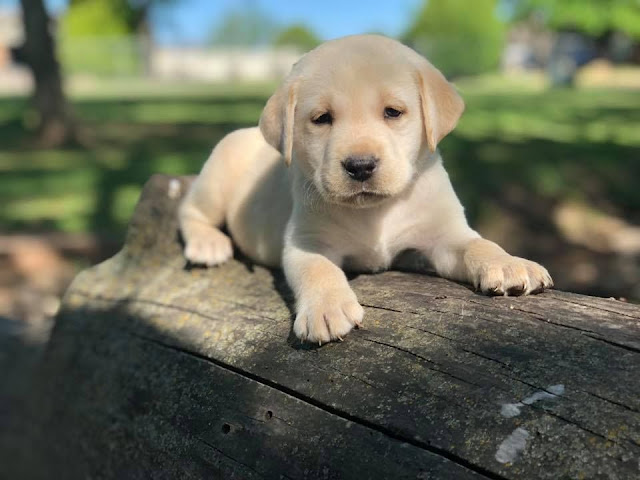
Pups bite when they play, chew through your best shoes and dig up your lupins. These are all natural and instinctive behaviors that most new Labrador puppy owners want to avoid, labrador retriever puppies near me.
learned behavior
Puppies also learn very quickly to behave in unapproved ways.
You think he should sleep on the floor, he thinks he should sleep on the couch. You think he should eat from his bowl, he thinks he should eat from the litter box. This is what might be called "naughty" behavior.
The concept of naughty is actually a bit wrong. Normally we have "trained" the puppy to behave in a certain way by offering a reward for that behavior.
If a puppy gets up on a sofa and gets a good cuddle or a nap on a soft cushion, he has received a wonderful reward. And we know that reward "reinforces" behavior. So the pup is likely to do it again. If a pup gets into the kitchen drawer, he'll be handsomely rewarded with delicious-smelling food scraps. Another splendid reward. Again, provided by you. So even if you didn't mean to train your pup to do these things, you did it unintentionally.
The three R's of puppy training
The three r
When you're out in the cold and frustrated by your puppy's behavior, it's good to think about the 3 R's. When a puppy misbehaves, we have three important lines of defense.
To restrict
redirection
Re-education
In this order.
To restrict
Restrict puppy training
The first thing to ask yourself is: Should my puppy have access to this part of the house/yard/person? There is no point in trying to teach an eight-week-old puppy not to bite, dig, tear, or bite everything in the first week of care.
We have to remind ourselves from time to time that a puppy who ruffles the legs of our chair and steals everything that isn't nailed down isn't bad, he's a puppy. Trying to train him not to do all those things at once is exhausting and useless.
Limiting your pup's access to your most prized possessions takes the pressure off both of you and allows you to train him at your own pace. We've talked a lot on this site about the importance of puppy containment. Last week we saw how to protect your garden from the attentions of your young thug. And there are several articles on puppy care and adult dog behavior that apply this approach, labrador retriever puppies near me. Puppy crates and baby gates can make your life easier and help you raise a
happy puppy, if used correctly.
Natural behavior has a way of expressing itself. If you prevent your puppy from chewing altogether, he may become anxious. Puppies need to be able to chew, chase sunlight, and play. So his second priority is to "redirect" natural behaviors, like biting, from his own objects to more appropriate ones, like kong toys.
There comes a time, of course, when your dog starts to learn new ways of behaving that you don't agree with. And when you want to teach your puppy new and better ways of behaving. When you've reached the limit of what redirection and restraint can accomplish, or when your pup is ready to learn a new and better way of behaving, training is the answer.
when you're away
Remember that "self-discipline" doesn't come naturally to dogs, especially puppies. Dogs need supervision. Left alone long enough, most young dogs get into trouble. No matter how well you've trained your dog, if you're not in the room with him, he won't be able to say to himself, "Hmm, this couch looks really comfy, but I'd better lie down on the floor because I'm not allowed on the chairs." furniture".
Dogs also don't know how to anticipate delayed consequences. He is unable to understand that "if I get caught on the couch during my nap, I can be punished." Dogs don't have the moral code to sustain that behavior. Your dog is not physically capable of rationalizing like an adult human would. He has no concept of "right" or "wrong", only of what he can be rewarded or punished. And delayed gratification is not his strong point.
If you're going to be away for a while, put your puppy or young dog in a safe place where he can't explore the potential of "grid" electricity or dismantle your precious photo album collection, labrador retriever puppies near me.
Simplify
Remember that if you have a conflict with your pup, whether it's over the contents of the litter box or the right to dig in your precious flower beds, keep the following three points in mind.
